
Someone asked me recently: "Is the internet profitable yet?"
It's a sarcastic question and it deserves a sarcastic answer. But hold it up to the light and it turns out to be useful, because the way we answer it shows how badly we misjudge transformative technology while it's actually happening.
The numbers are stupid
Between the 1970s and the 1990s, the US government spent somewhere around $325 million building the foundations of the internet. ARPANET, the NSF backbone, protocol development, research grants.
By 2022 the digital economy was generating $2.57 trillion in annual value. Call it a tenth of US GDP. Every year. Forever, as far as anyone can tell.
No spreadsheet has a cell for that. The internet didn't just mint some profitable companies. It rebuilt how humans communicate, trade, learn and organise, dissolved geography as a barrier to information, made remote work a thing at all, and wired global supply chains together. Try putting a discount rate on it.
Picture 1974
You're in a government budget meeting. Someone wants $325 million for an experimental computer network. There's a cold war on. The economy is a mess. And the pitch, honestly summarised, is: we'd like some university computers to talk to each other.
You have no concept of Google or Amazon, no notion of e-commerce or streaming, no idea what a "website" might be. What's in front of you is a modest research project with unclear applications, and behind it, invisible, fifty years of exponential curve.
The chart below is what was hiding behind that funding request. Nobody in the room could have drawn it. Look at the green line: the internet economy sat flat for thirty years before it went vertical. And that spike and collapse at year 30 is the dot-com crash, which felt at the time like the end of the story and turned out to be the intermission.
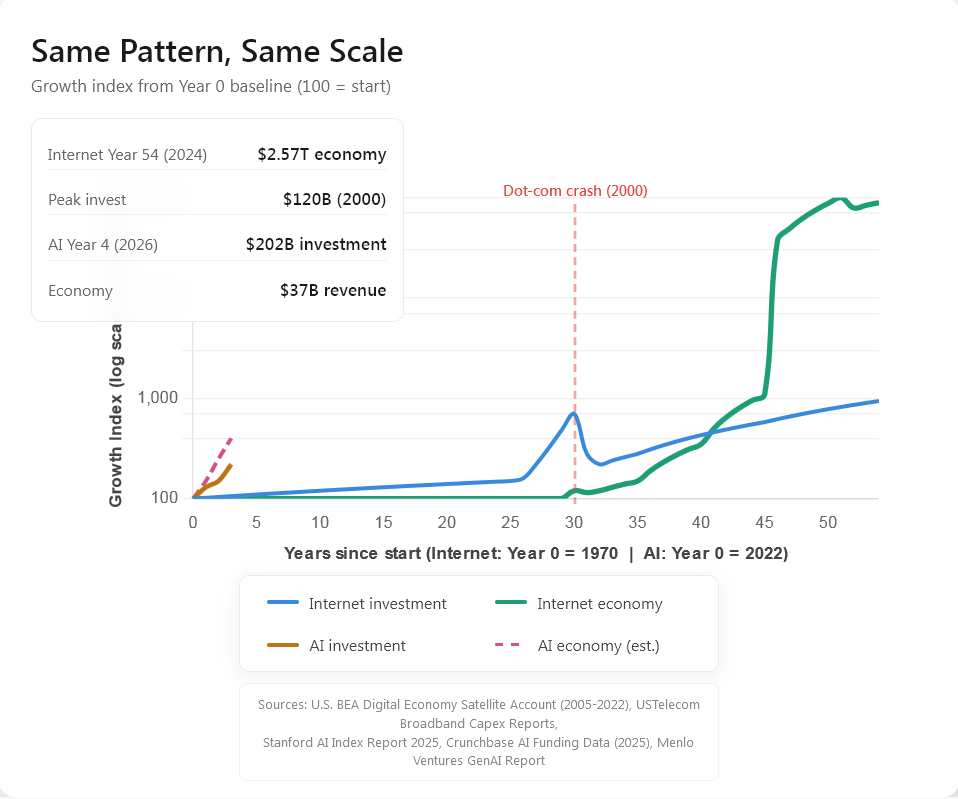
$325 million in. $2.57 trillion a year out. The green line waited thirty years to move.
Every generation gets one of these meetings. Nearly everyone in the room gets it wrong.
Enter AI
We're three years into the AI era, counting from 2022, when the machines started talking back. On the internet's clock, that puts us in 1974. The budget meeting isn't a thought experiment. We're sitting in it right now.
Annual AI investment has reached $202 billion against something like $37 billion in revenue, and plenty of sensible people look at that gap and ask when the whole thing turns a profit. Fair question. The internet wasn't obviously profitable at year three either. Or at year fourteen. Or, if you'd panicked and sold in 2000, at year thirty. By year thirty-five the question had answered itself.
One detail on that chart deserves attention: at year three, both AI lines are already running steeper than the internet's did at the same age. Maybe that's froth. Maybe the curve simply starts sooner this time. Either way, the shape looks awfully familiar.
The real question
Here's the part that matters, and it isn't the ROI.
The internet's returns never flowed back to the government that seeded them. They flowed to whoever could capture them. Some reached workers as new jobs and new trades. Rather more of it pooled in a handful of platform companies and their shareholders. $2.57 trillion a year, grown from a $325 million public seed, and most people see a sliver.
The internet created enormous value and enormous inequality in the same motion. Workers got displacement and wage stagnation with "gig economy" printed on the label. Now the same pattern is setting up again: massive buildout, mixed public and private money, unclear applications, gradual adoption, and then, if history repeats, the explosion. Explosions reshape everything around them.
We hold exactly one advantage this time. We've seen this movie before.
We know what happens next
AI will be profitable. That was never seriously in question, whatever the quarterly commentary says. The scale may end up dwarfing the internet's, because this technology performs cognitive labour, and cognitive labour is most of the wage bill of a modern economy.
Which direction it bends civilisation is the open question. Wealth concentrating further, until a few AI landlords collect rent on every unit of thinking? Or gains spread wide enough that the people displaced by the machines share in what the machines produce? The technology won't decide. Political economy decides, which means, eventually, we do.
In 1974, someone asked whether connecting computers would ever pay. They had no idea what they were building, and the astronomical returns went to whoever stood where the money landed. In 2025 we know exactly what we're building, and we know the returns will be absurd.
The only live question is who gets them.
The broligarchs or the people.